.blog-item-wrapper { background-color: #fff; max-width: 100%; } .blog-item-wrapper .post-title, .blog-item-wrapper .post-date {color: #f1641e;}
Courage, Practice, and the Heart of Not Knowing

3 Comments

Courage, Practice, and the Heart of Not Knowing

Written by Laura Jane Mellencamp, founder and owner of Yoga Among Friends.

This reflection was written during a period of extended study and collective practice in India, exploring courage, devotion, and how shared spiritual practice shapes the way we meet the world.

Courage is the measure of our heartfelt participation with life, with another, with a community, a work, a future. It does not arise from a mind linked to the need for outcome as a way to preserve the safety of survival. It rests in the heart of not knowing how and brings us to our knees to ask for help. Asking comes from the pain of being human and longing to move forward. Courage arises out of the broken heart and allows action to have meaning and purpose. Sometimes courage arises from a place of stillness—to just be present.

Last spring, I was invited to participate in a profound and humbling opportunity—one that asked far more of me than enthusiasm or intention. It asked for discipline, devotion, and a willingness to sit inside uncertainty.

The preparation itself was a true effort. I was asked to learn a Vedic mantra—the Sri Suktam—by heart, a practice that I found deeply challenging. My personal sadhana became the steady recitation of the mantra, again and again, each repetition asking for patience, humility, and trust.

Courage does not arise from knowing the outcome, but from the willingness to stand in the heart of not knowing.

As my confidence slowly gathered, I prepared to travel to India to participate in the Maha Sri Yaga—a shared spiritual practice of chanting and meditation held with the intention of uplifting humanity in a positive, loving direction. The journey brought me to Khajuraho, India, where my teacher, Pandit Rajmani Tigunait, has built a sanctuary for practitioners to gather and engage in these ancient sacred practices.

The Sri Suktam itself is composed of sixteen individual mantras, each invoking the power of Sri Vidya—the inner light—and the grace of the Divine Mother, the source of abundance and unity within collective consciousness. While the language and lineage are ancient, the experience of devotion and collective intention transcends words.

From the new moon in January through the full moon in February, I committed to rising at 5:00 a.m. each morning for prayer and meditation. Before the day began, I recited the Sri Suktam thirty times on my own, making every effort to complete the practice in the stillness of early morning.

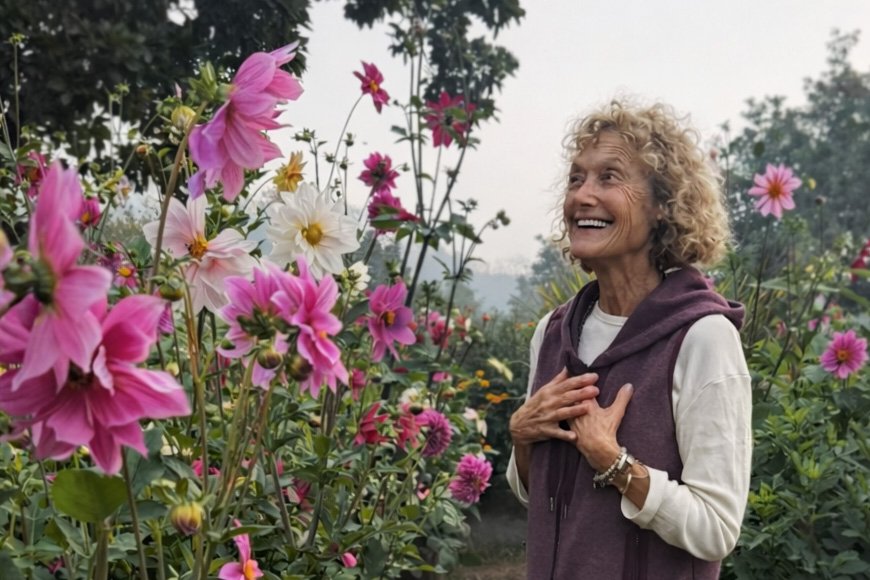
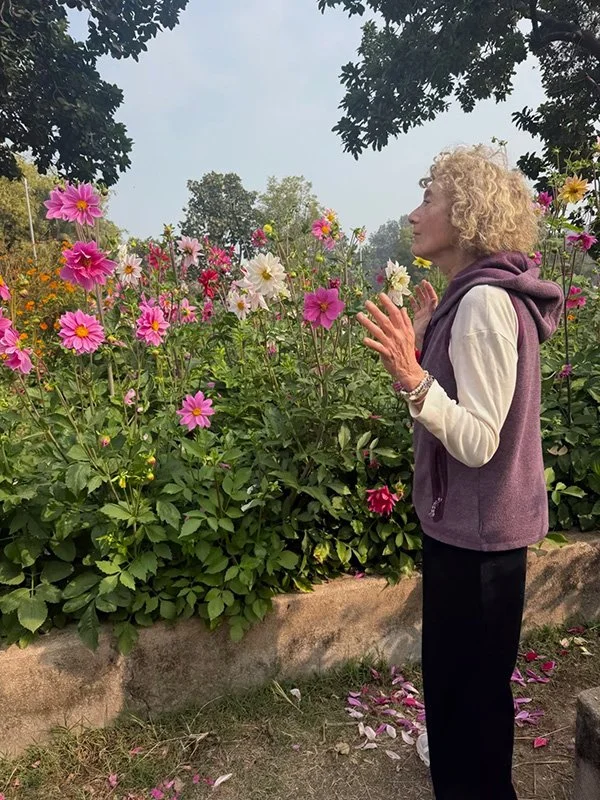
Laura Jane Mellencamp walking mindfully through a garden during her daily meditation practice in India, embodying presence and gratitude.

Breakfast follows at 8:00 a.m., and then I take my daily walk. For those who know me, walking is not about distance or pace—it is about presence. I walk to let my senses roam freely, absorbing the scents, sights, and sounds of this sacred place, allowing awe and wonder to arise naturally.

Later in the day, we gather for Panditji’s teachings, studying the depth of the tantric lineage and the profound power of mantra. Together, sixty practitioners chant the verses aloud twenty times in unison. The experience of group chanting cannot truly be described—it must be felt. Something shifts when breath, voice, and intention move as one.

My deepest preparation for this journey was not only memorizing the mantras, but learning how to surrender into the practice itself. I struggled to find the space and time until I realized that this work had to become my priority. In our endlessly busy world, I am still questioning—and listening to—the quiet pull of the soul toward devotion.

Many of my daily walks at home were consumed with chanting, and I’m sure my neighbors wondered about the woman “talking to herself” as she passed by. I arrived here as a humble student, not as a teacher—willing to make mistakes, to feel awkward, and to sit among brilliant practitioners from all over the world.

I came as a humble student, not as a teacher—willing to make mistakes, to feel awkward, and to begin again.
 
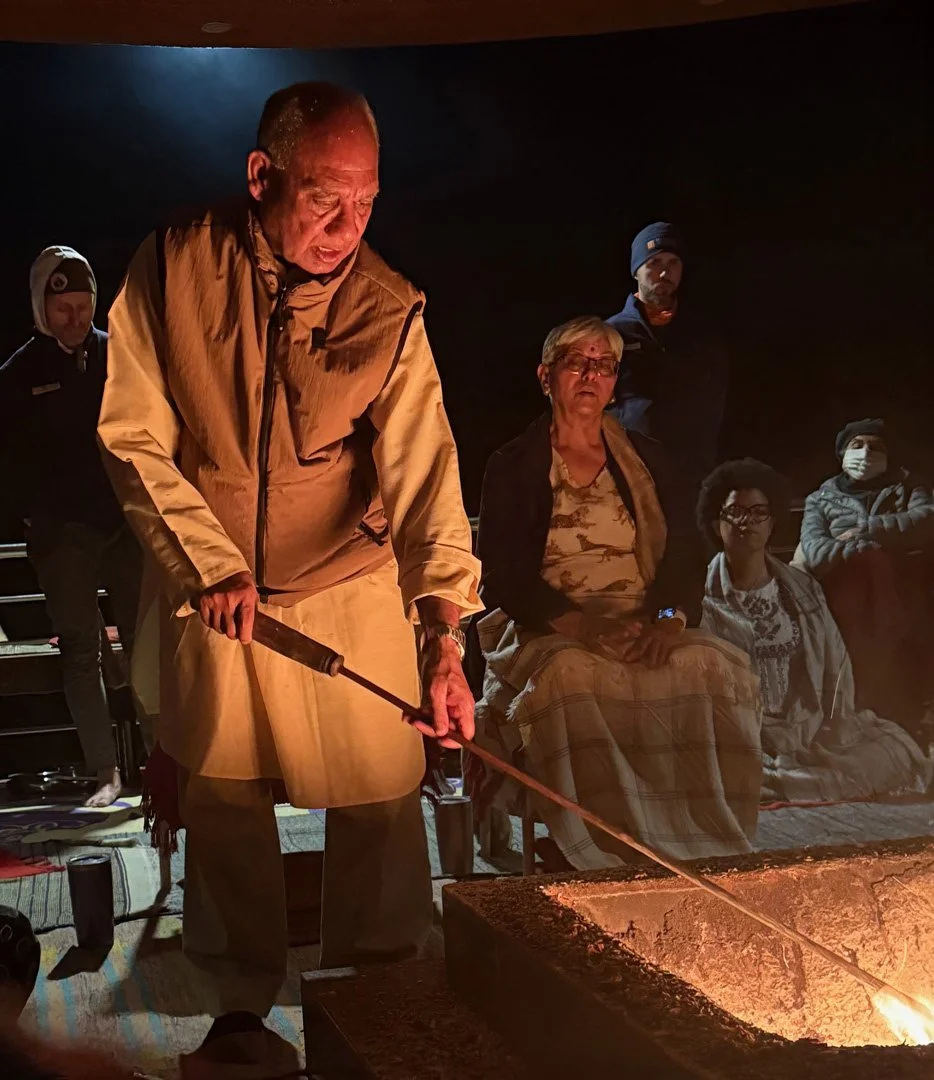
Sacred fire ceremony (Havan) during collective mantra practice in India, symbolizing devotion, ritual, and shared spiritual intention.

Sacred fire ceremony (Havan) during collective mantra practice.

Each evening, we gather for a Havan, a sacred fire ceremony. As Panditji chants the entire Sri Suktam, we make offerings into the flames with each mantra—repeated 108 times. Ritual slows us down. The fire invites reflection, purification, and transformation, reminding us that change often requires surrender.

I know I am deeply blessed to be here, especially as the world continues to struggle to find balance. News of suffering and conflict reaches us even in this sacred place. And yet, alongside the grief, I am witnessing something else—a quiet shift. People standing in solidarity. Hearts longing for peace. A collective call for a moral compass rooted in compassion.

“Never doubt that a small group of thoughtful, committed citizens can change the world. Indeed, it is the only thing that ever has.”
— Margaret Mead

The purpose of sadhana is not to change the world overnight, but to transform how we meet it. How do we encounter difference without closing our hearts? How do we listen deeply and hold space for the suffering of others? Every human being is carrying unseen battles, and who am I to judge another’s path?

The purpose of sadhana is not to change the world, but to transform how we meet it.

These reflections can sound lofty when anger is so present in the world. And yet, perhaps the work is to transform the fire of anger into light—to sense the possibility of another way forward. Courage is arising within collective hearts. Peace must begin in our own minds. The higher path does not begin “out there,” but within our own willingness to shift pain into purpose.

Pain itself is not a failure. It is often the great motivator—the force that moves us toward change, toward healing, toward joy.


When I return in February, once my body has settled from travel, I am committed to offering a morning meditation as a community service. This will be a gentle 45-minute practice, including pranayama and the introduction of a simple mantra, as we gather to support one another in meditation.

As we move through the harshness of winter toward the promise of spring, my intention is to gather our collective hearts. To remember that within dukkham—difficulty—there is also sukkham, sweetness. Together, we are moving in a better direction.

I am deeply grateful for your support and for this community we continue to nurture. May we create a healthy, vibrant space rooted in presence, courage, and compassion.

Om Shanti, Shanti, Shanti.


A gentle reflection:
What helps you return to presence when the path forward feels uncertain?

We’d love for you to share in the comments below, if you feel called.

Key themes: courage, sadhana, collective practice, meditation, community, transformation.

3 Comments

Awakening the Inner Fire Together

3 Comments

Awakening the Inner Fire Together

Reflections on warmth, practice, and steady presence

As I travel to the other side of the world, I may be in India physically, yet I am still holding space for my sweet studio and the energy of our community. I hear that Mother Nature is offering a deep freeze back home. From here, I can only extend the warmth of my heart and gently remind you that this, too, shall pass.

Historic stone temples in India lit by early morning sunlight, surrounded by greenery.

Places shaped by centuries of devotion and stillness. Practice, remembered.

We are hearty beings, capable of meeting obstacles as pathways for learning and growth.

There are many challenges unfolding right now—in our country and across the world. We are witnessing extremes everywhere, and even Mother Earth seems to be mirroring this through frozen terrain and stark conditions. Ice appears in many forms, and the tension continues.

In moments like these, let us return to the fundamental values of humanity as articulated by the great sages. Let us remember to keep our hearts warm and soften the armor of fear. A sincere practice allows us to reconnect with our truest self.

The central focus of yoga is the mind. The body is external, the soul eternal, and the mind stands between them—neither fully inside nor outside. It is the meeting place of body and consciousness. Problems arise when the mind is unsettled, for it influences both body and awareness. The teachings remind us that “the mind is the ground for both bondage and liberation.”

Where we place our attention matters. When our focus is consumed by fear—by what we hear and see in daily news feeds or by our inner chatter of worry and doubt—the mind becomes restless, like a jumpy monkey with no chance to discern what is true or wise. Such a mind forgets its innate strength and loses the protection that comes from one-pointed focus.

A red sun rising through mist above a garden path with trees and flowering plants.

A steady light, rising through the haze.


I am in India to deepen my practice, so that I may return home inspired—and inspire others in return. To remind us that, together, we can rise beyond the frozen layers of the body and awaken Agni, the inner fire in our bellies. We can move prana with intention and guide it gently toward the heart.

When the mind is calm, harmonious, and concentrated, we gain clearer understanding of ourselves and one another. We become better human beings, guided by a moral compass rooted in warmth and inner light. A tranquil, one-pointed mind is inherently creative.

From this space, we can stand up for humanity with the right words, at the right time, spoken in the right way—not from anger or fear, but from the conviction of the heart. A peaceful mind listens deeply and heeds the quiet voice of the soul.

Though it may be frigid outside, at Yoga Among Friends we gather to uphold the integrity of our community—with love, compassion, and care for all beings. We are stronger in this shared focus than in confusion or fear. Yoga offers us a path through asana and meditation.

When the mind becomes still, what happens? Yoga Sutra 1.3: Tada drashtuh svarupe avasthanam—we rest in our true nature. We see clearly that we are exactly where we need to be.


Keep the heart warm. Keep the inner fire lit as a gentle glow. And continue to be inspired as we create a peaceful home—together.

As we continue to tend the warmth within us, we’re reminded that steadiness often grows when we practice together.
A gentle reflection:
What practice, place, or ritual helps you return to steadiness?

We’d love for you to share in the comments below, if you feel called.

3 Comments

Home is in the Heart

5 Comments

Home is in the Heart

I’ve been practicing meditation for a long time. Only recently have I truly embraced patience—finally accepting that meditation is a process of preparation, a journey rather than a destination. The effort is not to arrive somewhere else, but to enjoy the act of focusing and to witness whatever is being revealed. I am no longer the driver; the car is being driven. I am trusting that I am right where I need to be.

Years ago, I was putting myself through graduate school while going through a divorce, moving every couple of weeks from one house-sitting job to another in Los Angeles. At the time, I had very wealthy celebrity clients whom I taught privately in their homes. I was blessed to be invited to live in those homes—taking care of birds, cats, dogs, and whatever else needed tending—while they were away filming some exciting project.

And yet, I was struggling. I could barely afford gas. I was living in a vast city filled with obstacles as a poor yoga teacher and graduate student.

One night, as I was moving from one address to another in the Hollywood Hills, it was pouring rain. I’ve been reminded of this memory recently as LA experiences rain and mudslides during the holiday season. I had all my possessions in a Trader Joe’s paper bag and was juggling an umbrella while trying to get into my car, parked on a steep hill. The bag soaked through, and suddenly all my dirty clothes were carried away by a river of rainwater flowing down the mountainside.

By the time I gathered everything and threw the soggy mess into my car, I was drenched. I sat there, wiped my wet face with whatever dry material I could find, and began to sob—my own messy, wet tears pouring out.

In that moment, I realized there was a name for my existence: homeless. I became acutely aware that I had no permanent address.

Later that night, I settled into yet another borrowed home. I was alone, feeling deeply sorry for myself, trying to piece together my reality. I began to chant Om. I could feel the vibration of my voice as a call for help. Suddenly, the sound began to shift, and a deep moan emerged.

I realized I was chanting the word home.

That sound became the expression of my deepest longing. In that profound moment, I connected to my heart. Grief softened into longing, and something inside me shifted. I understood—my true home was within me. I felt warmth and fullness in my heart. I felt protected, seen, and deeply loved.

"My true home was inside of me."

It was a true blessing, a moment that has stayed with me for over thirty years.

Within the next two years, I found the courage to leave Los Angeles and move to what I had heard in meditation as “the Heartland.” I arrived in the Chicago area and slowly found my roots in the rhythm of small-town life. From there, I helped create a yoga home where others could experience belonging and connection to their inner True Self.

Yoga Among Friends has become a home for many—a space grounded in safety, where we come together to explore what it truly means to feel held. Without safety, there is no growth. Without safety, there is no learning. Without safety, there is no healing.

Gray slippers resting on a woven mat near the studio doorway at Yoga Among Friends.

This past year, it has been especially challenging to witness how many people around the world have been uprooted—living with uncertainty, fear, and the absence of a place to rest. When there is nowhere to feel safe, it becomes nearly impossible to access stillness, to settle into the quiet of the silent night.

My husband has volunteered with World Relief for many years. He offered a small condo to a couple who escaped Afghanistan on one of the last planes to the U.S. They are here legally, and yet each day carries uncertainty. Though I can practice compassion, I cannot fully understand the depth of grief and fear they live with daily.

And yet, every day they offer prayers of gratitude for shelter, even while living with uncertainty. I have never met a more grateful couple. Their devotion has deepened my understanding of what mantra truly offers the human spirit. Om is not a chant of separation—it is a vibration of connection.

They are devoted Muslims, chanting prayers that carry the same resonance of love. Christmas, Solstice, Hanukkah, and Kwanza—these celebrations become one shared light of devotion. Whatever sound we choose, whatever tradition we follow, we are all reaching toward the same source of belonging.

I have learned that my sense of home is always connected to this greater vibration. It lives beyond walls and addresses. It exists in the heart, in connection, in presence.

I am not driving the vehicle of life. I am simply committed to listening. Years ago, I made a quiet promise to keep seeking that deeper place of home—again and again.

A Gentle Invitation

If you’re longing for a place to feel grounded, supported, and at home in your body, know that you are not alone. We invite you to join us in class.

Our ongoing classes offer a steady refuge—spaces to breathe, move, rest, and reconnect with what matters most.

Explore Classes
 

Home is in the heart.
Shine for others.

I look forward to sharing the unfolding journey in the New Year and continuing to hold Yoga Among Friends as a safe refuge where all are welcome, and all belong.

With love,

Laura Jane

5 Comments